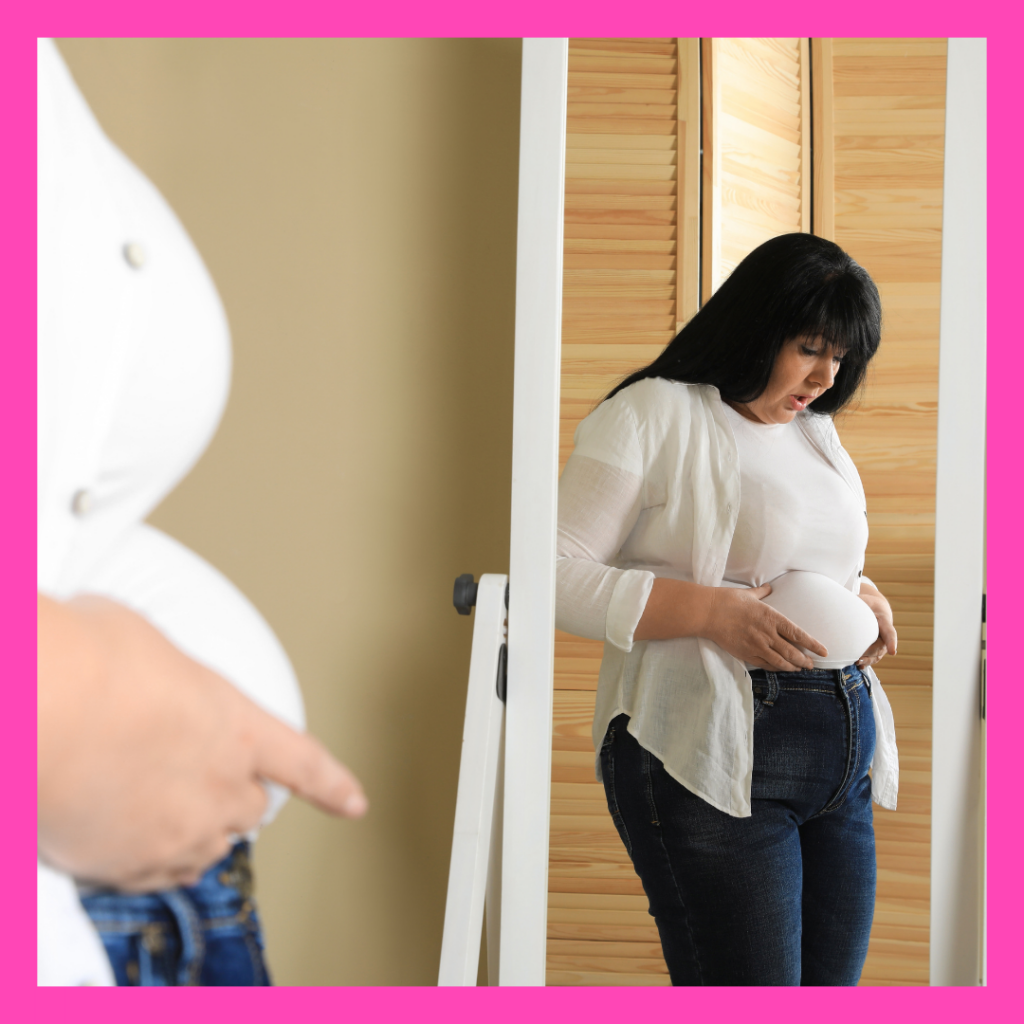
 It is often believed that perimenopause and menopause are the cause of weight gain, particularly belly fat, from 40 onward. However, there are many age-related factors that contribute to this increased belly fat. Both men and women gain weight over 40. Women taking hormone therapy find that even though all the menopausal symptoms may reduce, the extra weight gain does not necessarily reduce. There are many factors that contribute to this including:
- Reduced metabolism
- Reduced lean tissue such as muscle mass and organs
- Changes in insulin sensitivity
- Changes in hormones and fat distribution
- Changes in lifestyle, behaviour and stress
- Reduced activity
Reduced metabolism and reduced lean tissue (muscle mass and organs)
Studies have shown that people aged between 40-66 have increased body fat by an average of 1% per year in both men and women. There are changes in body composition, showing a decrease in lean muscle mass and an increase in body fat, both of which impact your metabolism.
From 40 years onward there is a decline in lean tissue, made up of things such as skeletal muscle and organ tissue. Skeletal muscle includes the muscles that sit over our bones and under our skin. Reduced organ lean tissue occurs in organs such as the liver.
Studies show that both men and women lose about 0.7% to 0.8% of muscle per year by the time they are 60. Together with the loss of muscle mass there is also a loss of muscle function. Your strength reduces by an average of 2.5% to 4% per annum.
The reduced muscle mass is often as a result of a reduction in physical activity as you get older.
Lean muscle is a huge contributor to the rate of your total daily energy expenditure (TDEE) which is made up of your basal metabolic rate (BMR), thermogenic effect of food (TEF) and your physical activity.
- BMR is the energy expenditure that occurs at rest simply to continue body functions such as the heart beating, lungs respirating etc.
- TEF is the energy expenditure that occurs during digestion.
Reduced insulin sensitivity
Insulin sensitivity reduces with age, increasing body fat, particularly visceral fat, the dangerous fat around the organs. Reduced insulin sensitivity means your body is not efficient as metabolising glucose. In lament’s terms, where you may have been able to consume higher levels of carbohydrates in your younger years, this changes as you get older. As such, you need to shift your macro distribution to consume less carbs than you once did to avoid extra fat stores.
Reduced insulin sensitivity can lead to metabolic syndrome, which is a collection of metabolic illness including diabetes and cardiovascular disease.
As you age, together with reduced insulin sensitivity, fat in and around the liver also increases. This can lead to fatty liver disease which further impacts metabolism.
The greater your muscle mass the more insulin sensitive you are. The more insulin sensitive you are the better you can metabolise glucose which means less fat stored and the more efficient your liver can function. That means you can eat more carbs without increasing body fat. This is one of the many reasons why it is important to maintain lean mean muscle.
Hormones and fat distribution
Transition through menopause you see a reduction in oestrogen and progesterone levels and an increase in follicle stimulating hormone (FSH). Reduction in oestrogen and progesterone doesn’t increase fat stores, but it does change where the body stores fat. Where distribution of adipose tissue would be to the lower and upper part of the body in the younger years, fat tends to store more around the midsection after 40. As well as the things we have already discussed earlier, during menopause as oestrogen and progesterone levels go down and FSH goes up, it leads to greater fat stores around the midsection. FSH inhibits thermogenesis (metabolism) and favours fat accumulation.
So even though menopause isn’t responsible for fat gain, it is linked to fat stores specifically around the midsection.
Changes in lifestyle, behaviour and stress
In your 40’s and beyond your responsibilities and lifestyle tends to change. You may be caring for children or grandchildren as well as aging parents. This is often when women tend to invest more into their career or change careers. All of which increases stress.
The hormonal changes that occur at this age also increases stress in your body. Reduction in oestrogen and progesterone can lead to sleeplessness, fatigue and mood swings, which also increases stress and can lead to sugar cravings, increased appetite and reduced insulin sensitivity. When you are stressed, your body goes into the fight or flight response, meaning it needs glucose as a quick burst of energy, hence the sugar cravings and desire for extra calories. This can lead to poorer food choices and overeating, which further increases fat stores around the midsection.
Reduced activity
Oestrogen and progesterone help reduce inflammation, so as they reduce inflammation in the joints increases, leading to join pain. When you experience joint pain, this can contribute to less movement.
It is common to spend time being far more active as a younger person, exercising, going out dancing, participating in outdoor activities, doing your own household chores, and chasing after young kids. As you get older these often tend to die down somewhat; you may not go out dancing and doing outdoor activities as much, you may outsource some household chores, the kids get older, so you tend to drive them to places more than chase after them.
As you get older and muscle mass reduces, you may find your fitness and strength reduce which may lead to reduced motivation to exercise the same way you used to.
General wear and tear of the body, injuries, reduced flexibility and mobility may mean you have to change the exercises and activities you once enjoyed.
Inactivity causes the domino effect of reduced muscle mass and metabolism therefore added belly fat.
Strategies to help reduce belly fat
- Increase your activity and increase lean muscle mass:
- Perform activation exercises, stretches and mobility exercises to improve joint mobility and overall movement.
- Participate in movement restoration activities such as:
- Massage
- Physio
- Chiro
- Acupuncture
- Foam rolling or rolling with a spiky ball
- Walking can be a simple way to increase activity at low impact.
- Increase your incidental activity by:
- Park further away from the shops
- Talk with your hands
- Walk further to hang your washing
- Dance around the kitchen whilst cooking
- Laugh loads
- Get social
- Participate in more outdoor activities
- Take the stairs whenever you can
- Strength training
- Consume protein in every meal (1.2g to 2g per kilo of body weight per day, for women over 40)
- Nourish your body:
- Drink plenty of water
- Limit sugar intake
- Eat plenty of fresh fruits and vegetables for vital vitamins and minerals
- Adjust your macros so that you are having higher fats and proteins and reduce your carbohydrate intake.
- Prioritise sleep. Ensure you get adequate good quality sleep as this is the time you burn the most fat.
- Manage your stress. Do activities that trigger the parasympathetic nervous system, which is the system that tells your brain it is time to relax and calm down.
- Meditate
- Breathing exercises
- Spend time outdoors
- Relaxation massage
- Write in a journal
- Write a gratitude list
- Have a warm bath, spa or sauna
- Gardening
- Arts and crafts
- Anything you love that helps you unwind.
Though belly fat will increase as you get older, one you understand why it is happening you can implement strategies to reduce and eliminate it.
- Coach Terri
Resources:
J Clin Invest. 2022 Aug 15; 132(16): e158451. Metabolic changes in aging humans: current evidence and therapeutic strategies. https://www.ncbi.nlm.nih.gov/pmc/articles/PMC9374375/
GGS Academy,(2023). Menopause Coaching Specialist Certification. Girls Gone Strong.