
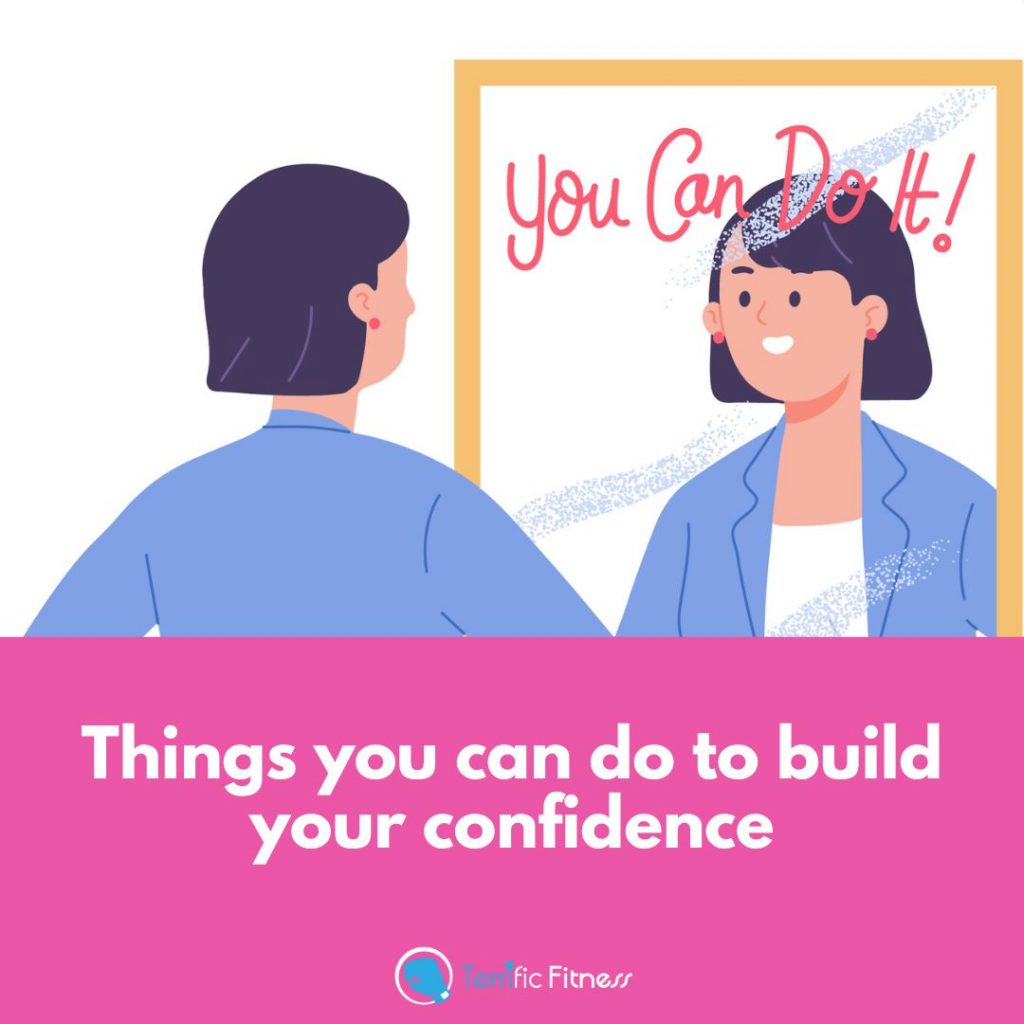
 Lack of confidence comes from your perception of not being ‘good enough’, which often comes from someone else’s perception of you not meeting expectation of some sort, that is then passed on to you. It often goes hand in hand with not putting your own needs first and constantly servicing the needs of others. Today we are going to go through ways to shift your mindset to help you boost your capabilities, and therefore your confidence. But it is going to require some work from your part. It doesn’t just happen.
Just a note to be mindful of before we continue: nobody is confident in everything. There is no such thing as a ‘confident person’. The more things you are confident in, helps you mask your lack of confidence in other areas that you lack in confidence. So when you are trying to improve your confidence, think about confidence in what? Be specific.
Ok, that said, let’s kick into some actionables to help you boost your confidence.
- Boundaries:
Before you do anything else, you need to firstly make time for yourself. You need to set some boundaries and set aside time for yourself. That is not being selfish, it is being self-less. Because the more you fill your own cup, the more you will then be able to give to others. If you keep giving to others without servicing your own needs, you will not be giving them your full potential because you can’t give from an empty cup. If you don’t make time for yourself, you will not follow through with the following exercises, and therefore will not be able to shift your mindset to boost your confidence.
Furthermore, understand that by setting boundaries you are teaching others how to treat you. How you treat you, is how everyone will treat you. By letting people know when you are and are not available (setting time boundaries), you and they will respect your time more. When that happens, you will have more time to work on your own needs, including building your confidence.
Set time aside each day, whether it is half an hour, an hour, whatever, to work on your mindset and confidence. You will need this time for the following exercises.
- Make a list of all the things you love about yourself, and how these characteristics serve you.
For example, ‘I love that I am a good listener, because it means my friends are comfortable coming to me when they need to get something off their chest.’
- What do I love – that I am a good listener
- How does that characteristic serve me – friends talk to me to help themselves
Here are some questions to help you, if you are struggling to come up with things:
- Are you punctual?
- Are you good at keeping secrets?
- Are you a good cook?
- Are you strong?
- Are you a capable person?
- Do your friends find you funny?
- Are you good with numbers?
- Make a list of as many things as possible, that you have succeeded in, completed or achieved, throughout your life.
- Beside each of these, list what strengths or characteristics it took in order for you to succeed in it, complete it or achieve it.
For example, completed a university degree. I needed:
- Persistence and perseverance in order to get through all the work
- I needed time management to get all the work done by the due dates
- I needed discipline so I could do my homework, research, study etc. in order to complete the curriculum successfully
Upon completion of this task, you have just added some more positive traits about yourself. It is a collection of these traits that helps you feel more capable. When you feel more capable, setting goals, assigning tasks to achieve those goals and then executing those tasks, are mor realistic. When you start to feel more capable, your confidence starts to increase, which then leads to more execution. You then find yourself in a circle of productivity and success. You feel capable, so you do more. The more you do, the more confidence you feel. The more confident you feel, the more capable you feel. The more capable you feel, the more you execute, and so on.
- Make a list of things you would like to improve about yourself or achieve and WHY you want to improve them or achieve them.
- List some strategies you can use in order to improve each thing.
For example, I want to improve my strength. Strategies I will use are:
- Join a gym
- Hire a strength coach
- Start a training program
- Commit to and attend the training program four times per week
The ‘why’ part is super important! It will be your motivator. So don’t skip this step. Make sure you detail your reason why. Be specific.
For example, saying you want to lose 5kg to feel better is not detailed enough. That won’t motivate you. Wanting to lose 5kg so you can run up the stairs without feeling tired and puffed out, so you can fit into a pair of jeans you love and be able to bend over more comfortably, collectively, are much more motivating than just, ‘to feel better’.
- What are some personal strengths you have that will help you achieve the above?
For example, a strength I have that will help me become stronger is that once I commit to something I follow it through to the end.
- List some roadblocks that might get in your way of achieving the above.
- List some strategies you can have as back up ideas to overcome these roadblocks.
For example:
- Roadblock – I have to stay back at work which will interfere with my training time.
- Strategy – Arrange a make up session, rather than just letting that session go by incomplete
- Make a list of how you will celebrate your wins, successes, progress or achievements.
If you don’t celebrate your wins, successes, progress, or achievements, you will eventually stop recognising the benefits of your investment. In other words, you will start to feel like you are wasting your time, because you cannot see what you are achieving. You will also start to resent the actions you are taking, and start sabotaging yourself, by not doing those tasks anymore. This will lead you back to square one, and leave you feeling depleted and further lacking in confidence.
By recognising and celebrating your wins, you increase your motivation and confidence to keep going, because you can see that you are progressing and you are not wasting your time.
As you continue to progress, you will start to feel more and more capable and worthy, which also contribute feeling more confident.
- Practice, practice, practice!
The more you do something, the better you get at it. The better you get at it, the better you feel about it.
Perform, review what you did, assess how you can improve, implement improvement ideas, perform again. Rinse and repeat until you become a natural at that performance and ooze confidence.
For example, if you are not very confident in public speaking, you need to do more public speaking. The only way to build your confidence, is through practice, reviewing, strategizing, implementing revisions and public speaking again.
Here’s another example: If you are not confident in wearing a bikini, try putting on a bikini top with a pair of shorts, and a loose shirt unbuttoned over your bikini top. Wear it at a beach where you don’t know anybody. Once there, look around; does the world go into a melt down by you wearing that outfit? No? Ok cool. Next time you go to the beach, wear the same outfit, but this time, no shirt. The following time, change the shorts to perhaps a short sarong. The time after that, remove the sarong. By this time you are wearing the bikini top and the bikini bottoms. Each time, you eased into it a little bit further until you wore nothing but your bikini. Eventually you will see that you cope just fine with that, and that your confidence has increased and improved with practice and time.
You can do the same, in just about anything in life.
- Avoid being judgemental, because this reduces how scared you are of other people’s judgement
Most people that are afraid of being judged by others, spend a great deal of time being judgemental themselves. Are you worried people will think you look silly in a bikini? Do you look at others and think someone looks silly? Shift the way you think about others, and you will stop being so worried about what others think of you.
- Become comfortable with being uncomfortable
Change and improvement comes from stepping away from your comfort zone. If you keep doing what you are doing, you will keep achieving what you are currently achieving. If you want to feel better about yourself, you are going to need to make some conscious changes, even if those changes make you feel uncomfortable, or are difficult. Avoid stepping away from a challenge.
Now that you have all the strategies, it is important you do the work it is going to take to move forward. Otherwise, you will just stay exactly where you are right now.
- Coach Terri